Speech & conversational AI
Reference transcription, diarization, acoustic events, language labels, intent, entities and time-aligned metadata.
ASR · voice agents · speech analyticsAI data annotation
Design label schemas, route complex judgments to trained specialists and preserve the decisions behind every reviewed asset.
Project-defined quality. Review coverage, acceptance rules and delivery requirements are configured around the program.
Task 1,284 of 4,000 · schema v3.2 · English
Multimodal by design
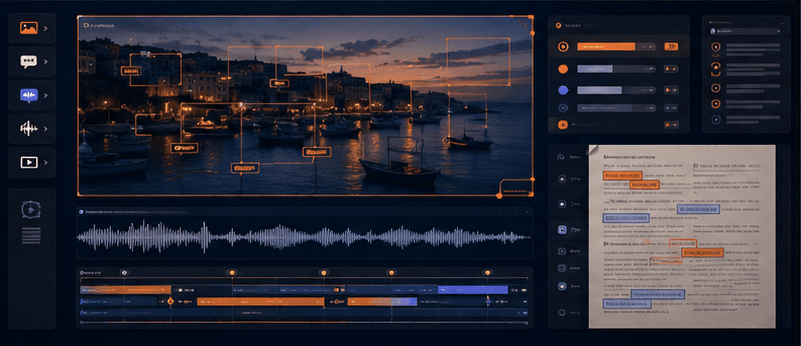
Speech, text, vision and video need different tools, but they should not require different project governance. Keep schema versions, contributor eligibility, QA rules, review history and delivery logic consistent across modalities.
Work from audio and transcript together. Mark speaker turns, entities, intent, acoustic events, language, uncertainty and time-aligned references without breaking the original asset context.
Ontology & instructions
Quality starts before the first task. Build the labels, examples, edge cases and acceptance rules into the workflow so contributors can make consistent decisions.
Create project-specific label taxonomies without rebuilding the interface for every program.
Keep examples, edge cases, definitions and policy notes available inside the annotation surface.
Track which rules were active for each batch, annotation and review decision.
Single-choice label · required · task-level
Quality architecture
A single aggregate “accuracy” number hides where labels fail. Build quality into the pipeline with calibration, gold tasks, independent judgments, agreement checks, reviewer sampling, rework and adjudication.
Use a pilot batch to expose ambiguous instructions and edge cases before the full program starts.
Route suitable tasks through multiple annotators and track disagreement as a signal about task clarity.
Resolve difficult cases with explicit rationale and retained history.
Human operations
Language, locale, modality, domain knowledge, qualification history and project clearance can determine who should see a task. Internal teams, vendors and reviewers can operate in one controlled workflow.
Model-ready delivery
Deliver structured annotations together with schema versions, task provenance, review state, quality metadata and dataset membership. Human-readable exports and machine-ready formats stay aligned.
Project-defined JSON, CSV, text, manifests or integration-ready payloads.
Preserve dataset and schema versions so model experiments can be reproduced.
Keep annotation, review, adjudication and acceptance events linked to each asset.
{
  "asset_id": "support-call-1284",
  "labels": [
    { "type": "intent", "value": "billing_issue" },
    { "type": "entity", "value": "Pro plan" }
  ],
  "review": {
    "status": "accepted",
    "agreement": 0.94,
    "schema": "3.2"
  },
  "provenance": "batch-08"
}
Use cases
The same platform can support training data, benchmark creation, human evaluation and post-training workflows without forcing every task into one generic annotation interface.
Reference transcription, diarization, acoustic events, language labels, intent, entities and time-aligned metadata.
ASR · voice agents · speech analyticsClassification, named entities, relevance, factuality, safety, rubric scoring, preference and structured response evaluation.
NLP · RAG · LLM training · evalsImage classification, boxes, regions, attributes, metadata and project-defined visual labeling tasks.
Retail · manufacturing · documentsTemporal events, scenes, actions, intervals and multimodal references connected to the underlying video asset.
Media · safety · activity recognitionPairwise preference, correctness, completeness, relevance, fluency, safety and custom rubric-based judgments.
Model evaluation · alignment · benchmarksLink audio, text, image, video and metadata when the model task depends on context across more than one data type.
Multimodal AI · agents · researchEnterprise control plane
Sensitive or high-volume annotation programs need role separation, task-scoped access, data-use rules, retention controls and traceable decisions built into the operating model.
Questions
Yes. Projects can define labels, nested attributes, examples, instructions, keyboard shortcuts, review behavior and delivery schemas without rebuilding the workflow.
Ready when the brief is clear
Tell us the modality, labels, model use case, quality threshold, languages, scale, review depth and delivery format. We’ll structure the workflow around the data you actually need.